When you can’t find work that pays a living wage, your life feels like an unending cycle of stress. But nobody should have to live paycheck to paycheck, let alone jobless with no way to afford basic necessities like food and housing. With the right programs in place and a concerted, well-organized effort to address obstacles to gainful employment, we can make it easier for residents to acquire the skills and connections they need to get and keep good jobs.
Households in the South Memphis Zone (SMZ), which includes all of ZIP codes 38106 and 38126, and parts of 38109 and 38114, make significantly less money each year than the Memphis and Shelby County median incomes–an average discrepancy of $14,653 (for Memphis) and $18,004 (for Shelby County). That’s enough to pay for more than a year of the average Memphis median rent of $1,187. It’s also more than enough to pay for a year of tuition at the University of Memphis. Not to mention the freedom from mental and emotional burden that $14K-$18K in emergency savings could provide.
SMZ residents also face higher unemployment, from 9.5 to 17.4%, than other parts of the city and county (See below).
US Census Data from Statistical Atlas:
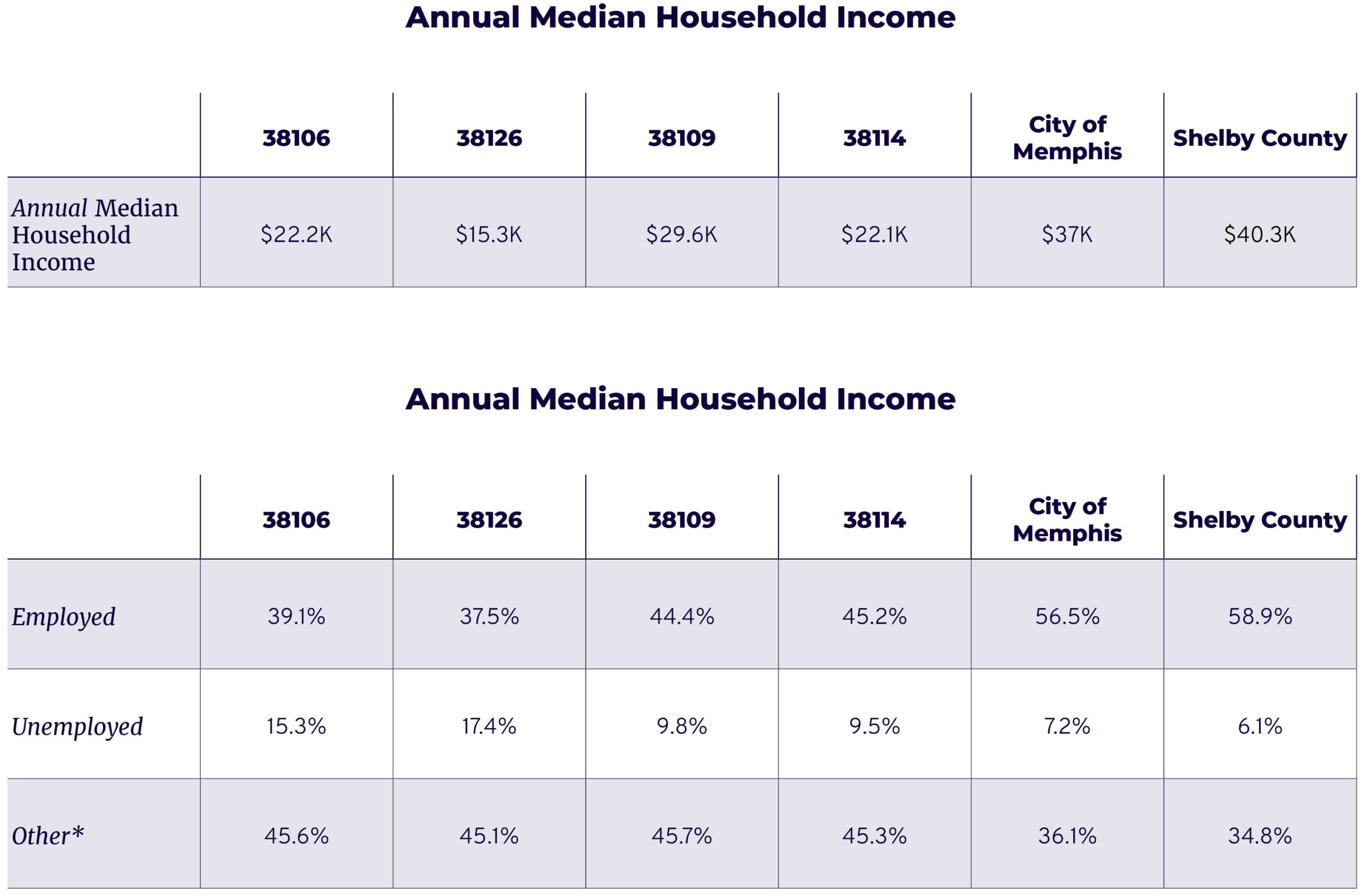
*Refers to population 25-64 years old who are not in the labor force
Our city’s economic environment needs a redesign. We need to make sure that young people are able to stick with school until they graduate 12th grade and start their college or career journey immediately after. Furthermore, we need to connect unemployed and underemployed people with job opportunities that both pay living wages and help meet the city’s needs.
As a collaboration among workforce leaders, schools, and other essential partners, the More for Memphis Economic Development workgroup has spent the past year focused on increasing the number of South Memphis Zone residents making a living wage.
One way to strengthen the SMZ’s economic outlook is to provide developmental support to new and existing small businesses owned by local residents. Start Co.–a venture architect firm that helps launch new technology, businesses, and more–meets entrepreneurs at any stage to bring their visions to reality. According to Start Co. President Andre Fowlkes, this kind of support involves an initial assessment and pinpointing “how to move a particular strategy from point A to point B, leveraging the resources that we bring from our team, but also our network here in the community.”
Examples of the South Memphis-based businesses Start Co. has worked with over the past year include Mara’s Wellness Spa and a music studio called Royal Studios. Focusing on work within the SMZ has helped the organization develop a more accurate perspective on the area’s specific needs and ask the right questions. “You know, Start Co., we don’t typically just focus on a few ZIP codes,” Fowlkes said. “We typically serve the entire city and the entire county. But taking a geographic approach has been great in terms of us really getting to know more of the partners within these neighborhoods, but also sometimes the lived struggle that many of these entrepreneurs are going through.”
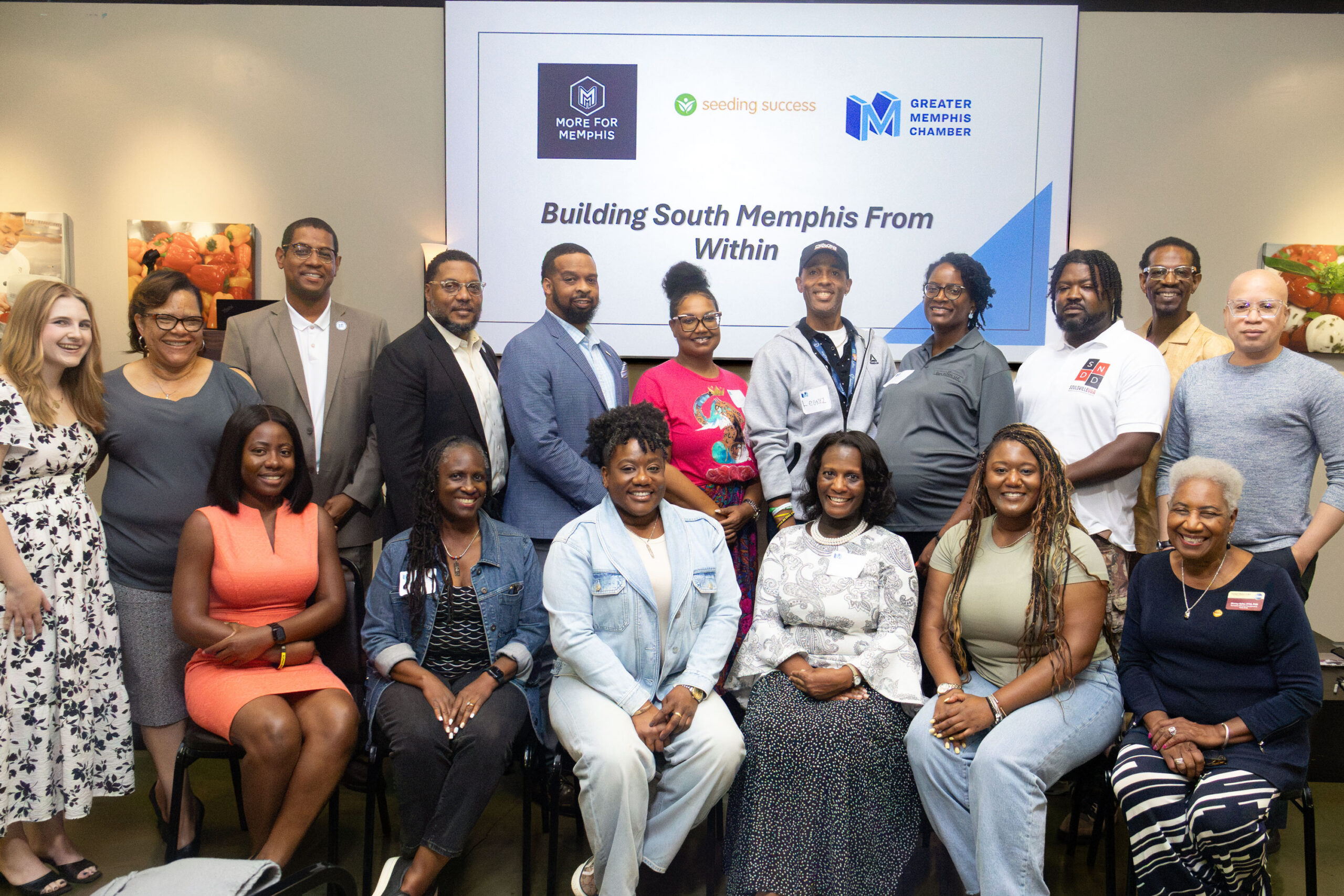
Another partner that is crucial to local economic development is the Greater Memphis Chamber. Through the More for Memphis project, the Chamber has offered business trainings, site tours, employment matchmaking sessions, teacher externships, and more to residents in the South Memphis Zone. A major piece of the puzzle was the “Building South Memphis from Within” training series throughout July 2026 that brought together teams of up to five community leaders to learn about economic development based in their South Memphis neighborhoods.
”It's going to create a lasting change because we are all thinking in the same direction.
Rosemary Konadu, Special Projects CoordinatorGreater Memphis Chamber
Sondra Howell (Senior Vice President of Workforce Development) and Rosemary Konadu (Special Projects Coordinator) were both involved in the South Memphis Zone Workforce & Economic Development workgroup. They emphasized that there are plenty of residents with brilliant ideas in the South Memphis Zone, but they need more resources to get their visions off the ground. “This additional support […] has just fueled the fire even more for success,” Howell said.
In addition to developing local small businesses, the Chamber is focused on ensuring training curricula for students align with what businesses need to build a workforce. Furthermore, the Chamber partners with community-based organizations to connect residents who need work with those trainings.
Howell highlighted the importance of building a talent pipeline that is sustainable for the long-term. The Chamber’s teacher externships–which are paid for by employers and help teachers get hands-on industry experience to share with students–are a great example of that kind of collaboration: “The teachers build long-lasting relationships with the employers post-externship,” Howell said. “Employers then have a direct connection with the schools and the students. They volunteer to come in and speak to the students. They host additional tours where they’re bringing students on site. Some of the employers even donate to the schools on a regular basis. And it just really creates that robust experience between the students, the teacher, and the industry, which is a significant part to building those career pathways.”
Konadu reported that she had her eyes opened by the collaboration within the Workforce & Economic Development workgroup. “It was good for me to get to meet these people and to learn about what they are doing in ways […] that we can support each other,” she said. “Everybody was just so in tune. I feel everybody loves South Memphis. Everybody wants to see investment come in there. Everybody came around to make sure that we had to do what we needed to do at that short time. I think it’s going to create a lasting change because we are all thinking in the same direction.”
This sentiment is shared by Matt Gould, Special Projects Coordinator for Dragonfly Studio, which supports Hospitality Hub–another key South Memphis Zone partner. “To have a purposeful convening where we all come together for one common purpose was super amazing to see,” Gould said. “People are experts in different areas, and so I learned so much stuff that I just never would have had that opportunity [to otherwise].”
Hospitality Hub, a nonprofit working to end homelessness in Memphis, is distinct from fellow Workforce & Economic Development partners mainly because of the population it serves. Still, the major focus of its participation in More for Memphis is getting local residents trained in vital skills and entering the workforce with living-wage jobs. According to Gould, organizations in Memphis serving vulnerable populations do not always know the full scope of services in the area. If knowledge of services was more widespread, these organizations could assist a resident and then refer them to other services they could also benefit from. That lack of interconnectivity “creates a blockade for folks in need of help,” Gould said, “so I think more of a collaborative effort for understanding all the different work being done would yield better results and provide us all with better opportunities to serve these populations.”
By exploring solutions related to employment and the economy together, rather than in silos, these partners have been able to make substantial progress in the South Memphis Zone. In short, helping people overcome the hurdles that keep them from getting good jobs and starting new businesses feeds into a positive cycle that improves the quality of life for everyone.
What are we doing?
Small Business and Entrepreneur Support
Start Co. is establishing an entrepreneurship incubator, offering capital investment, mentorship, and business development resources to small businesses and entrepreneurs.
The Greater Memphis area has more than 130,000 small businesses, making up 98.9% of all businesses. In 2021, these accounted for 41.3% of jobs here. That’s a huge portion of the economy, and by supporting start-ups dreamed up by South Memphis Zone residents, we can boost job opportunities for those who might otherwise struggle to find work.
Workforce Pipeline Improvement
RiseKit, Hospitality Hub, and the Greater Memphis Chamber are connecting young adults and families to high-demand job training programs, ensuring certifications and employment placements in key industries, such as healthcare and manufacturing.
Just graduating from school is often not enough to land a position in a viable career path. People who lack the connections, formal experience, or skills to enter the workforce deserve support to build their resumes, and our city benefits from a more stable, robust workforce.
College, Career, & Technical Education
The Excel Center, Greater Memphis Chamber, Memphis-Shelby County Schools CCTE, Southwest TN Community College, and SCORE are partnering to expand career pathways, vocational training, and technical education to better prepare students for postsecondary success and employment.
While certain sectors are seeing a tough job market, others are actually understaffed. But these roles require skills that need to be cultivated in classrooms and hands-on certification programs. By ensuring South Memphis Zone students are exposed to all their options and supported on their career journeys, we can fill critical gaps in the local economy. Better yet, we can help young people have healthier financial futures than the generations before them.
Pathway Fund
Seeding Success and Hospitality Hub are working together to provide up to $2,000 per person taking part in high-quality workforce training programs to help overcome barriers to completion, such as transportation, housing, food, and childcare.
By making these funds as easy as possible to access, participants are not forced to jump through hoops to stick with the programs that are meant to improve their lives. Instead, they can focus on the content of the course and stay engaged until employment.

Photo courtesy of the Excel Center
Workforce Progress in Numbers
Each person engaged through a More for Memphis workforce partner is taking a step toward a higher quality of life and having a positive impact on the local economy. We are proud to show what our partners have accomplished this past year.
As of October 20th, 2026:
- 10 students who enrolled in a specialized industry training course at Southwest TN have completed that course.
- 53 entrepreneurs participated in business accelerator programs.
- 10% were able to grow their revenue six months post-program. Many business accelerators are not yet at the six-month mark to provide revenue growth information.
- At least 71 SMZ residents attended a community resource forum, meeting 71% of the Year 1 goal.
- 93 people have received up to $2,000 to support their completion of workforce-related training through the Pathway Fund. The Year 1 goal was 75.
- 36% of Pathway Fund recipients have completed credentials, while 49% of participants are still actively enrolled.
- 27 Pathways participants have been successfully placed in jobs, and all of them are still at those jobs.
- 112 residents participated in career exposure tours, surpassing the Year 1 goal of 100.
- 336 people participated in innovation exchanges (including networking events and opportunities to learn from others.)
What We’ve Learned
- Access to training alone is not enough. Workforce strategies are stronger when barriers to participation can be fixed quickly and residents can be approved for support without facing additional hassle.
- When instructor constraints prevented the planned MLGW lineman training from moving forward, Southwest TN Community College shifted resources toward ACDC-related training rather than allowing the investment to go unused. Future work should continue prioritizing high-value credentials but stay flexible when provider capacity or scheduling changes.
- Many residents and community leaders who participated in Building South Memphis from Within want to do more. Interested participants with promising ideas can be guided into Start Co. programming to further develop business concepts that respond to community needs.
- Individual programs create greater impact when they are connected through common referral practices and shared information. More for Memphis will continue to focus on making sure referrals and outcomes can be tracked more consistently.
We Need You Too
This work has officially received funding to keep going! That means partners will continue to offer and even expand workforce-related services. To stay in the loop, follow More for Memphis on social media and sign up for our newsletter here.
We still want to get 10,000 residents to sign onto our letter of support, telling our local government leaders that we’re calling for positive change and that we know the way to get there.